Embodied intelligence / Research paper

Embodied-
Harness

Towards Recursive Self-Improvement
for Robotic Manipulation

Zhenxuan Fan1, Zhuoya Wang2, Yuqian Yuan1, Wenqiao Zhang1†, Juncheng Li1, Jun Xiao1, Siliang Tang1, Yueting Zhuang1

1 Zhejiang University
2 Huazhong University of Science and Technology
† Corresponding author

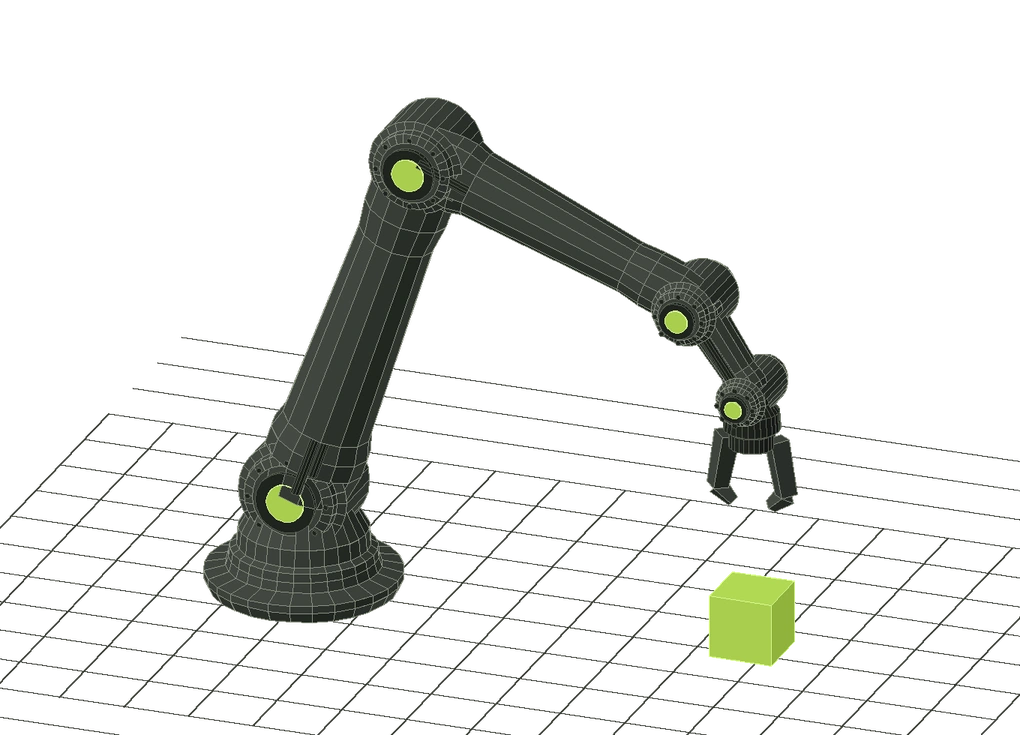
MANIPULATOR SCHEMATICISO VIEW
Isometric schematic of an articulated arm with a parallel gripper above a block.Revolute jointGripper
⌖ Robot manipulation SCHEMATIC VIEW
RoboTwin 2.0 / C2R82.4%
RoboSPA76.7%
RMBench94.4%
Real-world96.7%

PAPER OVERVIEW

Embodied-Harness at a glance.

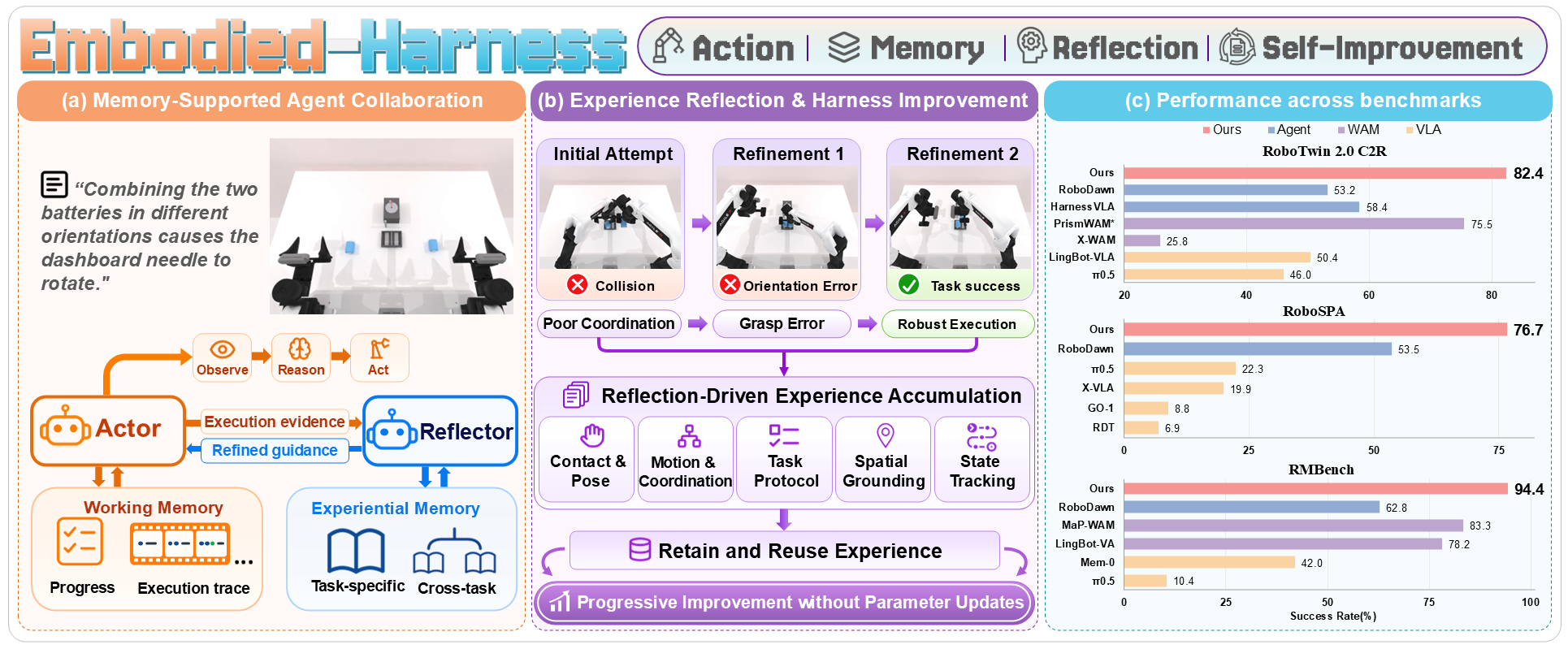
Figure 1 shows the Actor and Reflector exchanging evidence and guidance, successive attempts correcting manipulation errors, and success rates on three benchmarks.
Figure 1. Agent collaboration, harness refinement, and benchmark performance.Full resolution

METHOD

How the execution
harness improves

A failed attempt can tell a robot which operation to change and when to change it.

Embodied-Harness pairs two frozen vision-language agents. During an attempt, the Actor uses the current harness to execute robot commands. Afterward, the Reflector traces the outcome back to specific actions. What changes across attempts is the operational guidance in the harness: instructions about how to perform a manipulation and the conditions under which those instructions apply.

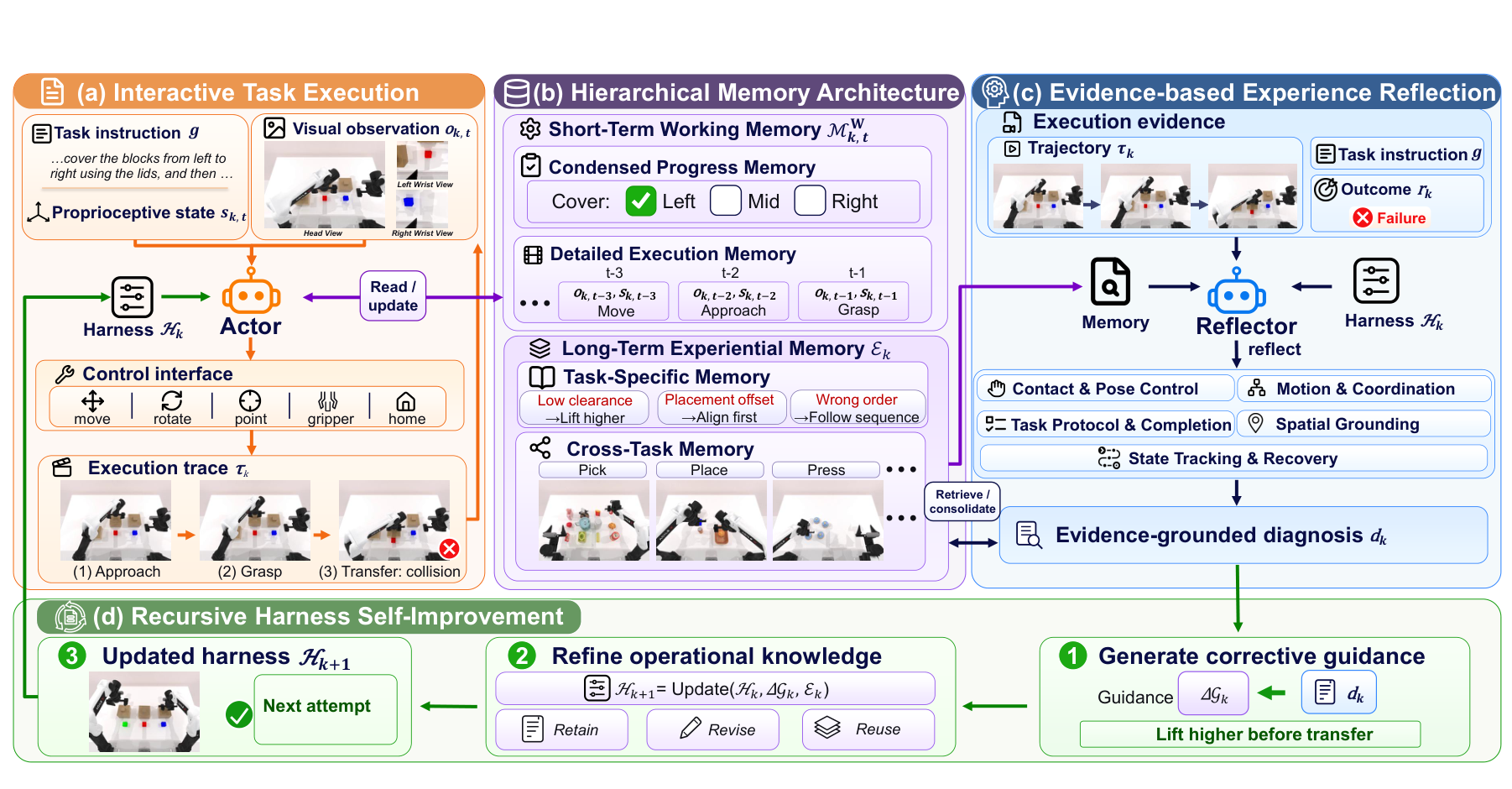
Paper diagram of the Actor’s control loop, hierarchical memory, and evidence-based reflection.
Figure 2. The Actor executes each step. The Reflector uses the completed attempt to refine the harness. Full resolution

Execute and remember

At each step, the Actor reads camera observations and robot state, then issues one of five commands: move, rotate, point, gripper, or home. For end-effector motion, the harness converts the arguments into a target pose and uses inverse kinematics to obtain a joint configuration.

Short-term working memory keeps two views of the episode. A compact summary tracks completed subgoals, pending operations, and constraints. A chronological record preserves observations, states, actions, and feedback so the Actor can adjust its next move and the Reflector can later inspect a particular step.

Diagnose from the trace

After each attempt, the Reflector compares the task instruction with what actually happened. It reads the trajectory and outcome alongside the current harness and long-term experiential memory. Task-specific memory supplies previous outcomes, diagnoses, and fixes for the same task. Cross-task memory supplies principles drawn from related tasks, such as how to coordinate a transfer or verify contact.

The Reflector assigns each diagnosis to one of five categories: contact and pose control, motion and coordination, task protocol and completion, spatial grounding, or state tracking and recovery.

Refine the next attempt

The Reflector turns its diagnosis into candidate guidance that names the operation to adjust and specifies when the adjustment applies. The update reconciles this guidance with accumulated experience, retaining effective instructions and revising conflicting ones.

The Actor executes the next attempt with the revised harness. That attempt produces a new trace, giving the Reflector evidence to refine the guidance again. Both agents keep the same model parameters throughout.

BENCHMARK RESULTS

Performance across settings.

Compare success rates under environmental variation, spatial and long-horizon reasoning, and memory-dependent manipulation.

REAL-WORLD EXPERIMENTS

On the robot.

The Piper robotic arm completed 29 of 30 evaluation episodes across three multi-step tasks. Select a task to inspect its execution sequence.